Diverse Experiences Igniting a Passion for Aerospace Engineering
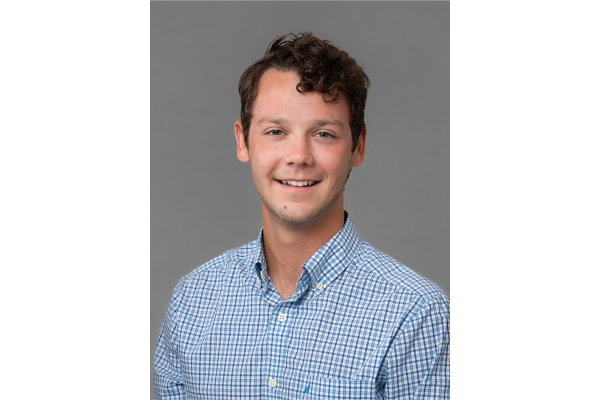
Portrait of Matthew O’Rourke. Courtesy photo.
Matthew O’Rourke, E ’26, MS ’27, mechanical engineering, completed three co-ops during his studies and is finishing a master’s degree with a concentration in thermofluids through the PlusOne Program. With a passion for aerospace engineering, he plans to use his skills to build technology that keeps people safe.
Matthew O’Rourke completed a bachelor’s degree in mechanical engineering and is pursuing a master’s with a concentration in thermofluids through Northeastern’s PlusOne Program. Growing up, he loved to build things, Legos in particular, and as he moved through school, he gravitated toward science while keeping up his hands-on interests, including woodworking, which he has practiced since middle school. By the end of high school, he knew he wanted to pursue engineering and that a degree would serve him well. Aerospace engineering had caught his attention, and mechanical engineering offered the most versatile, hands-on path to get there.
That affinity for practical learning led him naturally to Northeastern’s the Co-op Program. He appreciated being surrounded by peers who took their professional development seriously—a culture that suited him well, as he has always learned best by doing rather than sitting in a classroom. Hailing from Massachusetts, he had also long harbored ambitions to live in Boston, spending many weekends exploring the city before making it home.
Research and Co-ops
O’Rourke’s first hands-on experience was as a lab assistant at the Lustig Lab at Northeastern, where he worked on strengthening the Kevlar fibers used in bulletproof vests—contributing to a small-scale fiber production setup through prototyping and simulation. The experience gave him a window into academic research, and while he is grateful for it, he came away knowing that industry was where he wanted to be.
His first official co-op was at Specter Aerospace, a company developing aircraft capable of traveling at more than five times the speed of sound. As a propulsion intern, he was introduced to the world of engines and combustion, focusing primarily on ramjets—engine types that generate thrust by compressing incoming air at high speeds rather than relying on traditional rotating components. He learned to apply his engineering skills in a manufacturing context, using machines to fabricate parts and working in prototyping software, and also explored materials science questions about which materials hold up best in extreme atmospheric conditions. He thrived in the fast-paced environment and came away with a genuine passion for aerospace engineering that would shape every experience that followed.
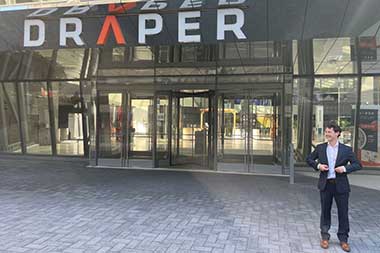
O’Rourke in front of the Draper building. Photo sourced from LinkedIn.
O’Rourke spent the bulk of his co-op time at Draper, a Cambridge-based research and development organization focused on advanced technology. He first joined as a mechanical engineer and systems packaging co-op, a role that broadened his understanding of how large, complex organizations function and how much collaboration underlies their work. He liked the environment enough that he continued part-time in their space programs while taking classes—a role with tight testing timelines that taught him to anticipate what the team needed before they asked. He later returned for a second co-op at Draper, this time as a space systems management intern. That position was more outward-facing, centered on strategic planning and representing the company at industry conferences. Seeing the difference between what engineers and what organizational leaders prioritized gave him a new appreciation for what goes into running a major technical organization—and helped him develop the networking skills to navigate it.
His most recent co-op was a deliberate departure: a role as an equity analyst at Boston Partners, an investment consulting firm. With no prior business background, O’Rourke dove into the world of markets and investments, learning about the Federal Reserve, economic indicators, and how to assess the value of companies in order to make recommendations to portfolio managers. Weekly speaker sessions connecting current market conditions to broader economic trends helped him translate what he was learning into something tangible. The role had nothing to do with engineering—and that was precisely the point. It gave him the chance to pursue a genuine personal interest and develop fluency in a field he hopes to connect with his engineering career down the road.
Extracurriculars and Mentorship
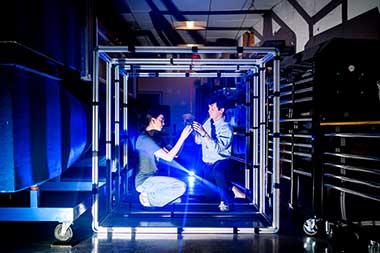
O’Rourke and his peer in the Satellite Lab. Photo by Matthew Modoono/Northeastern University
O’Rourke highlights two student organizations that shaped his time at Northeastern. The first is the Satellite Lab, formerly part of AeroNU, where he served for two years and eventually became chief mechanical engineer. The club worked on two satellites, and while O’Rourke contributed technically, his role gradually shifted toward teaching newer members how to use SolidWorks and explaining engineering best practices. He found the experience more rewarding than he anticipated—giving back in the way his own mentors had given to him. He now serves the club as an advisor. The experience also clarified something important about engineering leadership: the biggest part of the job is knowing your team well enough to delegate effectively.
The second organization is his social fraternity, Delta Kappa Epsilon, through which he built many of his closest long-term friendships—most of them fellow engineering students. He recommends Greek life to incoming students, particularly for the continuity it provides: when co-op season arrives and friends scatter across the country for work, having a strong social foundation already in place makes a real difference.
O’Rourke has been fortunate in his mentors. Professor of Chemical Engineering Steve Lustig, under whom he worked from his first year through his junior year, gave him his introduction to research and modeled what it looks like to genuinely care about students. His co-op mentors at Specter and Draper—Arun Chundru and Scott Young, both Northeastern alumni—brought a different kind of value. Having gone through the same clubs and co-op experiences themselves, they understood exactly what O’Rourke needed to get the most out of his time. They gave him meaningful projects, offered honest career advice, and were part of what nudged him toward pursuing a master’s degree. He plans to stay in touch with both.
Recommendations and the Future
O’Rourke’s advice to engineering students is to make room for interests outside the field. He appreciates how seriously Northeastern takes student career development but gently pushes back on the culture that can come with it. “Sometimes in a place like this we are almost a little too hyper focused on getting jobs,” he says, “and I think there is a middle ground that students should try to find.” The experiences he has had outside of engineering—including his finance co-op—have enriched both his career and his sense of himself. College, he believes, is the right time to take those risks. “Even if I did fail or make mistakes, my whole career would not go down the drain.”
This June, O’Rourke moves to Arizona to begin a full-time role at an aerospace startup. His core motivation as an engineer is clear: build technology that protects people. “How do we protect people and keep them safe?” is the question that drives him. Looking further ahead, he hopes to find ways to bring together his passions for engineering and investing—whether through business development, venture capital, or eventually starting a company of his own. Northeastern’s Co-op Program gave him the range of experience to know what he is capable of and the confidence to go wherever he can make the most impact.