Two Engineering Students Help Address Community Problems in Roxbury and Dorchester
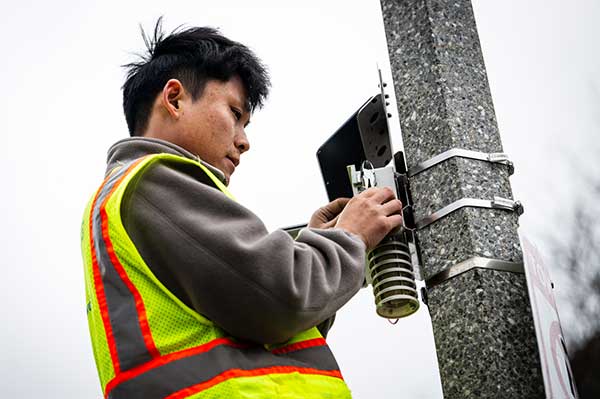
Ruifeng Song, a doctoral student in civil and environmental engineering checks a sensor in Roxbury for the Common SENSES Project. Photo by Alyssa Stone/Northeastern University
Northeastern students Ruifeng Song, PhD, civil and environmental engineering, and Kriish Hate, MS’26, mechanical engineering, are a part of a project called Common SENSES–an initiative aimed at giving community members hard data through sensors and an interactive map to back up claims of pollution problems in the area.
This article originally appeared on Northeastern Global News. It was published by Cesareo Contreras.
These Boston neighborhoods have heat and noise problems. This sensor project is helping address it
LaToya Johnson, a longtime resident of the Dorchester and Roxbury neighborhoods, remembers growing up with pollution from cars, trash on the streets and mice burrowing their way into homes.
While some issues have improved, such as the availability of more options for buying fresh and healthy food, she says the environmental concerns of extreme heat, poor air quality, and pollution persist.
“I hear about seniors sitting in parks, and it’s very hot,” she said. “Kids are running around and they are breathing in things that we don’t even know about.”
Circumstances may be changing for the better thanks to a partnership with Northeastern University, the city of Boston’s Office of Emerging Technology, and a few neighborhood advocacy groups.
Now, Johnson and residents like her will have data to support what they’ve long experienced.
That’s because Northeastern researchers and students have installed more than 70 environmental sensors in the Roxbury and Dorchester neighborhoods as part of the Common SENSES project, a new community-led research initiative using data to improve the city’s public infrastructure.
The goal of the project is to empower residents with data to back up their lived experiences, explained Dan O’Brien, a Northeastern professor of public policy and urban affairs.
O’Brien is also the director of the Boston Area Research Initiative (BARI), a multi-university collaboration that uses science and technology to help inform the city’s public policy and infrastructure changes.
“For residents to be bolstered by hard data — a sensor tracking every day what it feels like to live in a space — that can pack a little bit of extra heft and punch for their advocacy and for actions that might follow,” O’Brien, one of the principal investigators of the project, he said.
The sensors are collecting round-the-clock data on heat index classifications, sound pollution levels and overall air quality. That data can be viewed in real-time on interactive maps posted on the project’s website. The website also features stories from local residents sharing their experiences living in those areas.
Northeastern is working closely with two neighborhood advocacy groups on the project — the Dudley Street Neighborhood Initiative, of which Johnson is a board member, and Project R.I.G.H.T, which represents the Greater Grove Hall neighborhood.
In total, the researchers installed 74 sensors at locations based on feedback they received from more than a hundred residents at community workshops and public forums they hosted before the sensors were installed, explained O’Brien.
Fifty-one of the 74 sensors were built in-house at Northeastern and are being used to measure heat and noise, explained Amy Mueller, a professor of civil and environmental engineering at Northeastern University and a co-principal investigator.

Ruifeng Song, a doctoral student in civil and environmental engineering, and Kriish Hate, a masters student in mechanical engineering, routinely provide maintenance to the sensors. Photos by Alyssa Stone/Northeastern University
No bigger than desktop lamps, each of the units come equipped with a battery pack and a commercially available solar charging system to ensure the sensors have enough energy to function, a cellular modem to transmit the data wirelessly, and a SD card to also store data within the device, said Kriish Hate, a second-year engineering master’s degree student at Northeastern University who played a key role in their development and manufacturing of the sensors.
Read full article on Northeastern Global News