The Blending of Physics and Engineering to Generate Positive Change
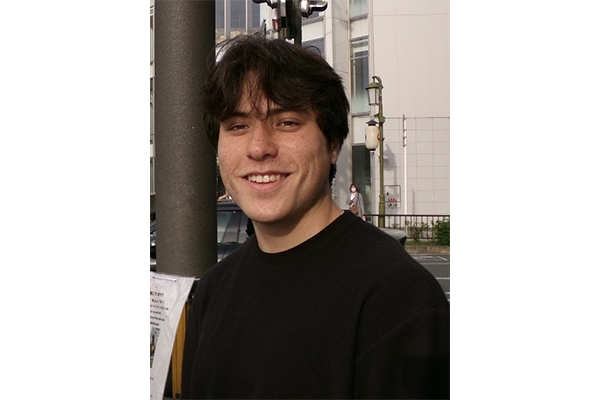
Brennan Bezdek portrait. Courtesy photo.
Brennan Bezdek, E’27, mechanical engineering, is currently on co-op at the MIT Department of Material Science and Engineering. Combining this experience with his vast array of research endeavors at Northeastern, Bezdek is planning to pursue higher education with the motivation of creating a positive impact.
Brennan Bezdek is currently pursuing a bachelor’s degree in mechanical engineering at Northeastern. Bezdek has always had an interest in science and actually enjoyed taking AP Physics in high school, which led him to consider an engineering school when applying to colleges. He chose to first major in electrical engineering, but later shifted to mechanical engineering because of the broad scope of the field. He wanted to study a discipline with vast applications, and almost any industry requires mechanical engineering.
While he was initially drawn to Northeastern because of its location—and proximity to the school where his sister is matriculating—it was the Co-op Program that deepened his interest. Recognizing the valuable opportunity to gain industry experience, along with the commitment the university provides for its engineering students, reinforced his interest. Upon visiting the Boston campus, he realized his path at Northeastern was “what you make of it.” Drawn to that freedom, he applied.
Research, co-op, and projects
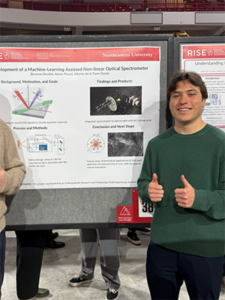
Bezdek presenting research at RISE. Courtesy photo.
Bezdek is currently an undergraduate researcher in two labs: the DeLTA Lab and Yoon Lab. The DeLTA Lab focuses on studying quantum physics and materials. Bezdek’s main project there is to help build a second harmonic generation spectrometer. This device is used to classify quantum and biological materials by shooting two low energy photons on the sample. In response, the sample will combine these photons with one high energy photon which reveals the structure of the material at the atomic level. With this project, they won the PEAK Summit Spring 2025 award for research funding and have filed a provisional patent for the device.
At Yoon Lab, Bezdek focuses more on the electromechanical field and works on building a breakout box for a cryostat pump used in pump-probe spectroscopy. In simple terms, they use this pump to scan materials at extremely low temperatures where different properties are able to emerge, while using voltage to excite the material to be able to “see” the sample at different parameters. In his role, he created a custom breakout box to control the voltage magnitude into the cryostat and each pin’s respective location to accurately examine the samples they are studying.
Another project Bezdek has worked on, where he won his second PEAK Summit award last fall, relates to the emerging subject of quantum cavity materials. His project focused on creating defects (holes) on photonic (silicon) crystal slabs to simulate photonic crystal cavities, using different electrical fields and studying the samples responses. For example, they would study how different arrangements of defects—such as in a square or hexagonal formation—would affect the response to the fields, while adjusting the frequency of the electrical fields to be optimized to what they need to study.
Since January, Bezdek has been a mechanical engineering co-op for the MIT Department of Material Science and Engineering (DMSE). Their current research focuses on reducing copper waste in the U.S recycling process. Currently, most waste facilities use expensive technology or sort scrap metal by hand to find copper to put back into circulation, yet the world faces a projected copper shortfall of 6-10 million metric tons annually by 2035. Bezdek’s role is to aid in the process of finding a new sensor to accurately classify and sort copper grades more efficiently. They are using a technique called magnetic induction spectroscopy, which uses alternating magnetic fields to test a sample’s conductivity. Since every material responds differently to a magnetic field, the group can use those responses to understand the composition of a material. Although the technology is in its infancy, they hope to use that technique as well as other sensor technology to be able to classify a pile of scrap metal with high accuracy.
He is grateful to Northeastern for providing these experiences. Bezdek has been able to develop his technical, coding, mechanical, and lab skills while working in labs and internships. He believes that being mentored by professors who have successfully followed his desired career path will afford him the opportunities he needs to thrive, as well.
Influential courses and mentors
One of the courses Bezdek enjoyed was Quantum Mechanics (PHYS4115), taught by Professor Gregory Fiete. As his first elevated collegiate physics course, Bezdek dove into interesting complex physics topics he had never encountered before, awed by Professor Fiete’s knowledge and depth of understanding. The course opened his eyes to a new passion—frontier science discovery—and inspired him to further commit to research, using physics as a guiding principle. A similar spark came from his Intro to Material Science with Assistant Professor Yoseob Yoon, whose commitment and care—both in the classroom and later as a research supervisor—left a lasting impression on Bezdek.
Lastly, Bezdek highlights Assistant Professor Alberto de la Torre Duran, with whom he has been conducting research for about two and a half years. He identifies Professor Torre as one of the most influential people in his academic journey, someone who encourages his science-driven nature and remains open with his students—never hesitating to inform them of new opportunities. “He has been one of those mentors that have really helped me progress throughout my time here,” Bezdek says.
Outside of class and research, Bezdek serves as a Presidential Ambassador for Northeastern, giving private, customized tours to donors, alumni, and prospective students and working events attended by university president Joseph Aoun. He has enjoyed contributing to occasions like graduation, commencement, and alumni events, where he has been able to meet new people and build a network of peers and fellow alumni. Bezdek is also part of the campus club soccer team. Having grown up with the sport, he was excited to play again in college and find an outlet outside the lab. Through the team he has found his community at Northeastern, forging lifelong friendships—some of his teammates are even his roommates.
Advice and ambition
One of Bezdek’s most important pieces of advice is to “don’t be afraid to reach out—everyone wants to help.” Coming from Texas, he did not immediately understand his place in Boston or Northeastern, which made him hesitant to connect with others early on. But once he did, he realized that most people are there to help and push one another toward success. He wishes he had found that confidence sooner, as it has led him to some of his most valuable friendships and communities at Northeastern.
Looking ahead, Bezdek plans to pursue a PhD after completing his bachelor’s degree. His interest remains in materials science, but he also wants to emphasize science policy—an area he feels strongly about. He wants to help people make informed decisions about new technology and its impact on the world, embodying the knowledgeable and compassionate qualities he most admires. His driving motivation, in his own words, is “to make the world a better place, and to create a positive change.” —one he will carry with him as he continues pushing for greater efficiency in the materials science field.