New Space Engineering Club Set to Launch Their First Satellite
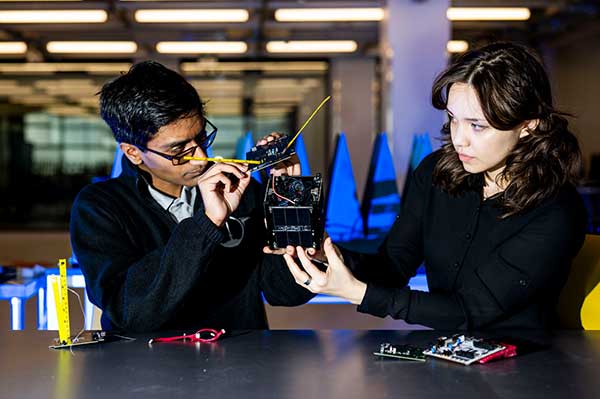
Northeastern Satellite Lab president Ganesh Danke, who studies computer science and chief mechanical engineer Laura Tomarossi Teixeira, who studies mechanical engineering, showcase satellite components in in the EXP building on the Boston campus. Photo by Matthew Modoono/Northeastern University
Northeastern’s Satellite Laboratory will be launching their first satellite with a resupply mission to the ISS. Coming from Aerospace NU, the club branched out to focus on their own ambitions, hoping to give Northeastern a permanent place for spacecraft engineering research.
This article originally appeared on Northeastern Global News. It was published by Cesareo Contreras.
Students reach for the stars with launch of first satellite
A satellite about the size of two Rubik’s cubes that was developed by Northeastern University students will launch into space aboard a SpaceX Falcon 9 Block 5 rocket next month.
This will be the first launch for the Northeastern Satellite Laboratory, a newly formed student organization spun out of Aerospace NU, the university’s long-standing aerospace operations organization.
The launch from the Cape Canaveral Space Force Station in Florida is set for April 8 as part of a cargo resupply mission to the International Space Station.
The satellite will be deployed from the ISS —which is approximately 250 miles above the Earth’s surface — to orbit for the better part of a year or so before burning as it falls back down to Earth.
The students have been working on the project for years as part of a smaller club within Aerospace NU, but decided to branch out as an independent organization as their ambitions have grown, explained Danke.
One of the primary objectives of next month’s launch, born out of NASA’s CubeSat Launch Initiative, is to showcase the satellite team’s engineering skills, Danke said.
It’s also been an exercise in collaboration.
Northeastern has partnered on the project with four other universities — California State Polytechnic University, Pomona, Columbia University, University of California, Santa Cruz and Texas State University — which will have their own CubeSat satellites orbiting the Earth.
Each satellite will also have its own experimental payloads aboard, used for testing.
The project has also been critical training for the Satellite Club as it prepares to take on an even bigger mission next year, explained Josep Jornet, a professor of electrical and computer engineering and the adviser of the club.
“The way I see it is that this has been a great way for our students to learn the key building blocks of a small satellite and the very strict constraints and design processes they need to follow to launch this into orbit,” Jornet said. “So that gives me peace of mind next year when we launch our terahertz satellite. It’s like before you can drive a Ferrari, you probably want to practice a little bit with your Chevy.”
The club plans to hold an official launch party next month on the day the satellite is scheduled to launch.
“We’re planning on using the event as a huge commemoration of all our progress — setting that milestone of Northeastern [launching] its first spacecraft,” said Laura Teixeira, a fourth-year mechanical engineering student and the organization’s mechanical chief.
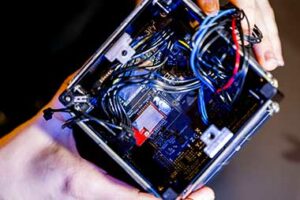
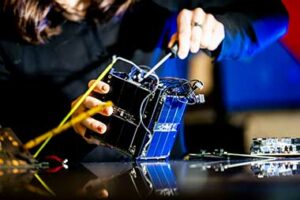
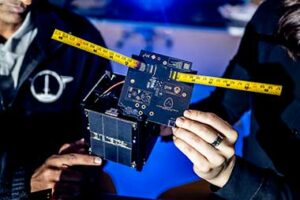
Pictured below: Northeastern students showcase components that were used in the development of the satellite. Photos by Matthew Modoono/Northeastern University
 |
 |
 |