New AI Design Framework Uses Light to Pack More Data Into Ultrathin Materials
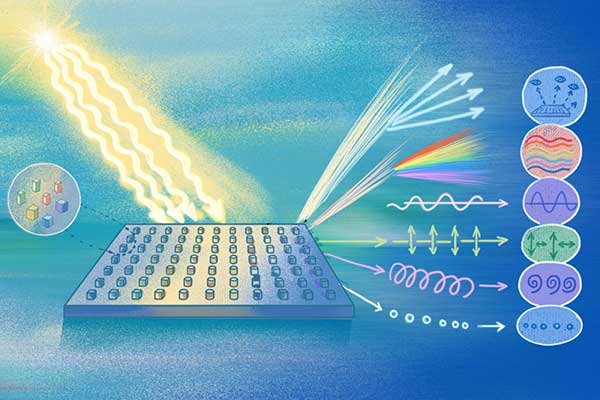
MIE/ECE Professor Yongmin Liu was awarded a $448K NSF grant for “Pushing the Multiplexing Limit in Metasurfaces via Physics-Informed and Data-Driven Approaches.”
This article originally appeared on Northeastern Global News. It was published by Cyrus Moulton. Main photo: Engineering professor Yongmin Liu wants to create photonic metasurfaces that can manipulate multiple properties of light. llustration by Renee Zhang/Northeastern University
Seeing AI and its power constraints in a new light
Northeastern professor Yongmin Liu develops optical, or photonic, metasurfaces that can control light.
Many environmentalists see electrical power as one of artificial intelligence’s major constraints, as processing data, running complex software models and cooling a data center requires a continuous, high-density flow of electricity.
Northeastern University engineer Yongmin Liu sees power and AI in a different light. Quite literally.
“We really want to develop new optical devices that use light to manipulate and to detect, transmit, and also to do some processing,” said Liu, a professor of mechanical and industrial engineering and electrical and computer engineering at Northeastern.
“By using light, we can do machine learning and deep learning with extremely low power consumption,” Liu said.
Liu develops optical, or photonic, metasurfaces that can control light. These surfaces include a human-made array of nanostructures, extremely miniscule structures measured in nanometers and that are not visible to the naked eye.
With a recent grant from the National Science Foundation, Liu wants to “establish a virtuous loop between photonics and AI.” In other words, using artificial intelligence to design new photonic structures, devices and systems, which can then be used to propel advancements in AI that can be applied once more to photonics and so on and on…
A major goal is to develop new metasurfaces that expand upon manipulating only one property of light, such as the angle by which light hits a surface, into simultaneously controlling multiple properties like color or frequency.
Liu sat down with Northeastern Global News to explain how light can both power and advance AI and more.
Read full story at Northeastern Global News