A Commitment to Accessibility and Community with Fatima Mumtaza Tourk
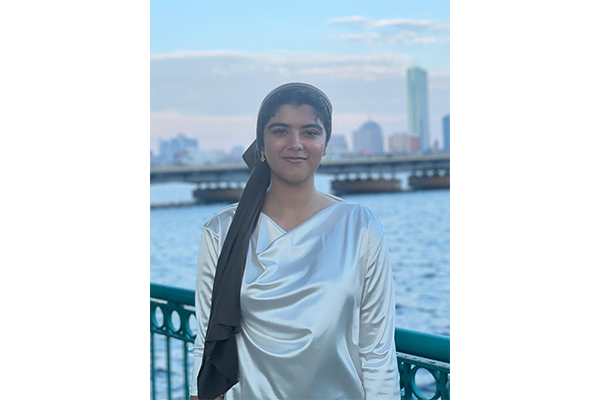
Portrait of Fatima Mumtaza Tourk. Photo Credits: Victoria Manjarrez, Alyssa Stone/Northeastern University
Fatima Mumtaza Tourk, MS’25, PhD’27, mechanical engineering, focuses her research on improving accessibility to assistive medical devices. With two current research projects that include exoskeleton devices for the hip and ankle, Toruk is committed to give access to novel mobility aids to everyone.
When Fatima Mumtaza Tourk first shadowed a prosthetics clinic as an undergraduate biomedical engineering student, she recognized unmet needs in how medical technology reached and served patients. Her belief — that assistive devices should be more accessible, adaptable, and patient-centered — has driven her entire PhD journey in Mechanical Engineering.
Tourk’s path to Northeastern was shaped by hands-on experiences that progressively deepened her desire to improve medical technology. After earning her bachelor’s, she interned at a lab focused on social and medical robotics before joining a tissue engineering lab at Harvard Medical School. There, she built a robotic arm 3D bioprinter and provided mechatronic support for other tissue engineering projects. Through these experiences, Tourk envisioned a future where she could meaningfully contribute to those in need and saw a PhD as the best way to develop the skills to be able to achieve her goals.
Now at Northeastern, Tourk leads two major exoskeleton projects that sit at the intersection of robotics, rehabilitation, and accessibility. Her first project produced a customizable, lightweight, and completely 3D-printed hip exoskeleton, along with a control system that Tourk developed herself. She is now using her design in a real-world case study, working on using the device for a patient with Parkinson’s disease to help alleviate their unique gait issues. Tourk’s hip exoskeleton design has already been shared with the University of Washington, where it is being used in several experiments. Her and her team are in the process of making both the control system and the hip exoskeleton design open-sourced, so that anyone can use it as part of their research.
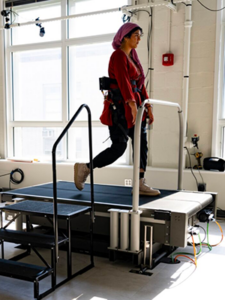
Tourk testing the hip mobility aid. Photo Credits: Victoria Manjarrez, Alyssa Stone/Northeastern University
Her second project takes a different but equally innovative approach; this time focused on the ankle. Tourk developed a data-driven controller that applies the concept of uncertainty awareness to the exoskeleton’s function. In practice, this means the controller can sense whether the wearer’s current action is something the exoskeleton has encountered before and knows how to assist with. If it hasn’t, the controller automatically turns the device off as a safety mechanism, a critical safeguard for real-world use. Creating technology that adapts to and assists the human body across the full diversity of body shapes and movements is, as she described it, “an infinitely wide question, and one that never ceases to surprise me. I am continually amazed at the human body and how even the simplest action that we take for granted has so many moving pieces.”
Tourk sees the impacts of her research as deeply important to supporting human connection. Limitations in mobility restrict autonomy, health, and the ability to function fully within one’s community. She points to the growing prevalence of mobility challenges across populations, from children who have lost limbs in conflict, to people of all ages living with neurological and muscular conditions, to the increasing population of older adults facing Parkinson’s disease, strokes, and other mobility-inhibiting conditions. Making accessible, patient-tailored devices is not just an impressive engineering feat – it is a matter of preserving people’s ability to interact with the world on their own terms.
Beyond the Lab: Building a Department Community
Tourk’s impact at Northeastern extends well beyond her research. When she arrived, there was little community infrastructure for Mechanical Engineering PhD students, as her department lacked a student council. Together with her friend Soha, they built one from scratch, establishing regular seminars, coffee hours, kickball tournaments, mentorship networks, and local community events. They even helped the Mechanical and Industrial Engineering department run the annual PhD Research Expo and welcome barbecue. The council recently received official university recognition, and as Tourk hands off leadership to the next executive board, she is both proud of what was accomplished and excited to see where it goes. Her advice for prospective PhD students considering Northeastern echoes her passion for connection and demonstrates her empathic spirit, “Find and/or build your support network and lean on them when you need them, and be patient with yourself. Skills take time to learn and research and ideas take time to develop.”
After graduation, Tourk plans to continue developing and improving access to assistive and rehabilitative medical technologies. She hopes to build a future with healthcare technology that provides a more effective rehabilitation experience and greater autonomy for people with mobility impairments and disabilities, regardless of where they live or how wealthy they are. Tourk’s journey is a testament to what happens when a researcher has a deep purpose – they commit not only to advancing knowledge, but to building the communities that sustain it as well.
Read a preprint of Fatima Mumtaza Tourk’s most recent paper here
Article originally appeared on PhD Education