Thermal Management Breakthroughs Developed for Extreme Space Environments
MIE Associate Professor Yi Zheng spent his summer collaborating with NASA engineers to develop advanced thermal management materials, including heat-harvesting cells and phase-change gels, designed to prevent battery explosions and withstand extreme space environments.
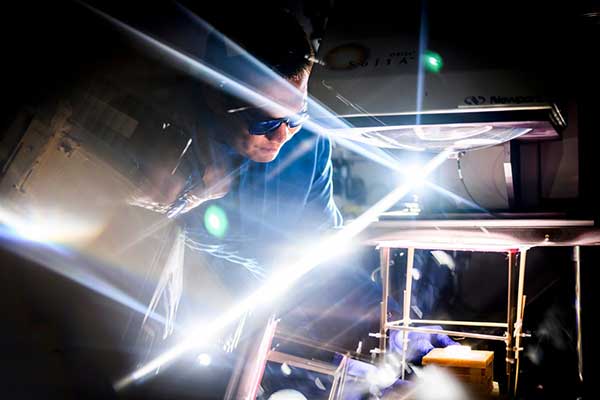
This article originally appeared on Northeastern Global News. It was published by Rich McKay. Main photo: Northeastern Professor Yi Zheng, seen here in a university lab, spends his summers at NASA to bring lessons back to class. Photo by Matthew Modoono/Northeastern University
Professor Yi Zheng of the College of Engineering spends summers at NASA
Summer break space race keeps Northeastern Professor eyes on the future technology.
In the space business – heat is a problem. Too much heat on space crafts and rovers, and components will crack, break down, or even make batteries explode. It’s why spacecrafts are regularly equipped with heat shields. Too little heat in space, and electronic components won’t work in the frigid cold. It was the case with the Mars Opportunity rover, whose failed heaters after a dust storm froze its internal electronics and ended its mission to find water on the red planet.
That’s where Yi Zheng, an associate professor in Northeastern’s Department of College of Engineering, comes in.
From a device that sops up heat to charge electric batteries on spaceships and Mars rover to a near fireproof, heat-stabilizing gel that can stop old spaceship batteries from getting hot and exploding, Zheng has worked on these and other projects with the goal of minimizing heat in space.

NASA’s Glenn Research Center in Cleveland, Ohio, where engineers design and test new space and aeronautics technology. Photo by NASA
“I teach engineering, but at heart, I’m an engineer too,” said Zheng. who spent his past six summers working on all those projects for NASA at its Glenn Research Center in Cleveland, Ohio. It’s where engineers design and test new space and aeronautics technology.
He does these annual 10-week stints because working in the agency’s labs allows him to see theory meet real-life engineering challenges.
For NASA, the idea is to bring in fresh eyes from an experienced university professor to help space engineers solve real problems, space agency officials said.
Northeastern professor Yingzi Lin, the chair of Department of Mechanical and Industrial Engineering, said that having professors out in the “real world” working with NASA engineers is a feather in the cap for the university, helping to build the university’s prestige.
“It’s a good collaboration for us and may lead to potentially more with NASA,” Lin said. “It also helps professors to go out there, have new experiences, and bring them back to the classroom for our students. There’s a lot of interest in space.”
NASA senior engineer Michael Halbig helped select Zheng to come to the summer program out of more than two dozen applications.
“He is strong on thermal analysis modeling and thermal management,” Halbig said of Zheng. “He’s a great communicator, a diligent worker.”
Read full story at Northeastern Global News