Northeastern Engineering Professors on the Lack of Representation in Medical Research
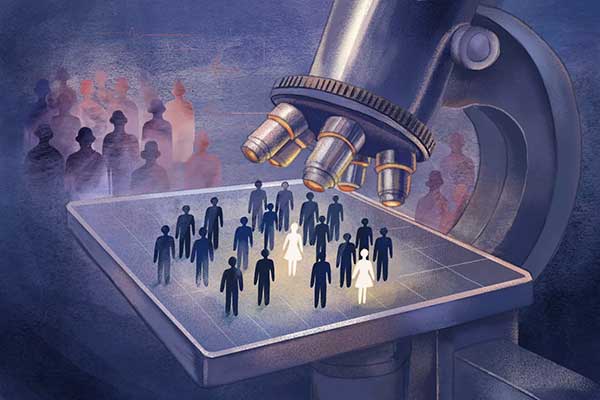
Illustration by Renee Zhang
MIE/BioE Professor Sandra Shefelbine and BioE Associate Professor Chiara Bellini discuss the lack of representation of women in medicine and medical research, specifically in their research areas of bone biomechanics and cardiovascular health–respectively.
This article originally appeared on Northeastern Global News. It was published by Noah Lloyd.
Where are the women? Researchers are on a quest for more representation in medical research
In the Interdisciplinary Science and Education Complex on Northeastern’s Boston campus, models of human bones line shelves alongside machines that measure how much force it takes to break the real things.
It’s the lab of Sandra Shefelbine, a professor of bioengineering and mechanical and industrial engineering, who studies bone biomechanics. That includes how bone develops, adapts and changes in various conditions, such as with “hip hinge” sports, like hockey, that require players to bend over in a forward position.
Some of her recent research has focused on a hip joint condition called cam morphology, in which young players of these sports develop a bump, or cam, in part of their thigh bone, or femur. The cam forms in what’s known as the femoral neck, the narrower part of the bone directly below the part that fits into the hip joint.
“Bones are smart material,” Shefelbine says, because they adapt when the weight that they carry changes. That’s why children are especially prone to developing a cam in high-impact sports like hockey.
But during the course of her work, Shefelbine came up against a glaring discrepancy. Even though two-thirds of the patients who experience this hip deformation are female, 95% of the studies on the condition only included men.
The omission was particularly alarming because, over time, a cam narrows the amount of space that the femur has to maneuver within the hip joint and can lead to hip arthritis in adulthood.
“Surely they’ve looked at this in females, surely,” Shefelbine recalls thinking. “Nobody’s looked at the formation of this bump in females, really?”
Shefelbine is not alone in picking up on the omission of women in scientific literature. In recent years, many books have exposed the systemic exclusion of women from science and the scientific process. Medications for conditions that affect men and women equally were approved based on studies that only included men. It was only in 1993, when Congress passed a law requiring the inclusion of women in clinical trials, that things slowly began to change.
The cost of this exclusion, meanwhile, is adding up. Kay Van Wey, a medical malpractice lawyer with over 40 years of trial experience, says that she sees “patterns of preventable errors” in her cases. Part of the problem is that, “Protocols, clinical practice guidelines, algorithms are developed for a wide range of conditions,” she says. Unless it’s something commonly considered “a female issue,” Wey says, “We’re getting health care that’s standardized for a man.”
Researchers at Northeastern are trying to change that. Shefelbine is leading studies that intentionally include female subjects. Other researchers are studying other aspects of the human body, including changes to the cardiovascular system during and after menopause and differences between sexes in how neurological structures develop.
Rebecca Shansky, professor and chair of the psychology department at Northeastern, says that many issues that are specific to women’s health, like reproductive health or menopause, “are seen as ‘niche.’ Even though, you know, we’re half the population.”
Closed doors
The exclusion of women and female subjects in medical research is not for lack of trying. Beyond the 1993 law requiring women to be enrolled in trials, the National Institutes of Health (NIH) in 2015 released guidelines on considering sex as a biological variable in conducting medical research. Researchers who hope to get NIH funding must provide “strong justification” rooted in data to study only one sex.
Other institutions have tried to make changes over the years. In 1999, the American Heart Association published a “Guide to Preventive Cardiology for Women” and a 2014 European Union regulation specified that categories of people likely to use a new medication should be included in the trials for that medicine, with special protections for pregnant and breastfeeding women.
Shansky notes that, anecdotally, from visiting labs and giving talks, there are still a lot of holdouts, which can mean that studies on males and females aren’t “part of the same story, from a publishing perspective,” she says. Studies in female subjects can wind up as an afterthought.
That’s a problem for many reasons. Kejal Kantarci, director of the Women’s Health Research Center at the Mayo Clinic, says that the “historical data that inform current medical treatments are often based on research that was conducted mainly on men. Or, when women were included, the research didn’t account for differences between women and men.”
Without the systematic inclusion of study subjects that can provide insight into the biological differences between male and female subjects, research that forms the basis of medical care will continue to be flawed, researchers say.
“Women go to the doctor because they have a certain set of symptoms, and because the disorder that they might actually have has never been described or studied through a female lens, the doctors are just baffled,” according to Shanksy. It’s not just that doctors may not have the right — or any — answers.
Gaps in medical knowledge could also lead to what’s known as medical gaslighting, where a doctor doesn’t believe the patient is experiencing what they claim to be. Approximately 50% of women report having experienced medical gaslighting at some point in their lives, according to independent research platform Worldmetrics.
Medical gaslighting, Shansky continues, occurs far more frequently among “women and people of color because they don’t fit this very specific, textbook, male set” of symptoms.

“It’s actually shocking when you look at the underrepresentation of female” subjects in cardiovascular health studies, says Chiara Bellini, right. Photo by Adam Glanzman/Northeastern University
Overlooking those symptoms can have deadly consequences. Chiara Bellini, an associate professor of bioengineering who focuses on cardiovascular research, says that “It’s actually shocking when you look at the underrepresentation of female” subjects in her area, she says, especially since heart disease is the leading cause of death among both women and men in the U.S., according to the Centers for Disease Control and Prevention.
Bellini studies a condition known as aortic stiffening, where the aorta — the largest artery in the human body — loses its elasticity as it ages. That flexibility is important as it allows the aorta to maintain blood pressure levels. An aorta that stiffens too quickly, Bellini explains, can be a sign of premature aging.
Read full story on Northeastern Global News