Engineering Faster Drug Delivery: A PhD Journey in Fluid Mechanics
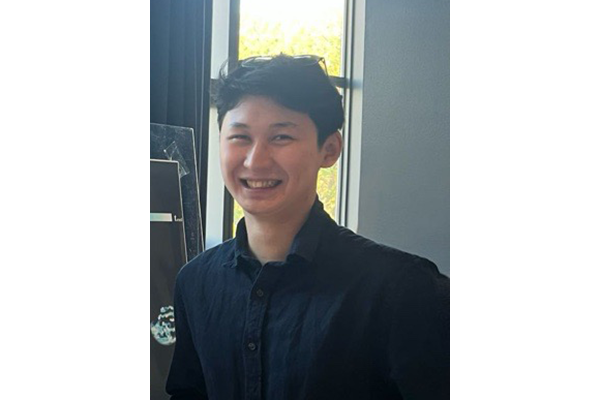
Portrait of Langqi Xing. Courtesy Photo.
Langqi Xing, PhD’28, mechanical and industrial engineering, currently works in the Multiphase Transport Research lab as a graduate researcher. Drawing on his interdisciplinary background and experiences at Northeastern, Xing plans to pursue an industrial role advancing fluid mechanics applications in medicine.
Langqi Xing is completing his PhD in mechanical and industrial engineering at Northeastern University. He completed his bachelor’s degree in chemical engineering at UC Santa Barbara, where his passion for improving people’s lives and protecting the environment began to take shape. His undergraduate research reflected these interests, focusing on capillary flows in suspensions and cohesive grains for dust removal, as well as modeling the physics of rockslides and avalanches.
Coming from a family of engineers, Xing was naturally drawn to the field. During his undergraduate studies, he recognized that a PhD would advance his career and allow him to continue doing the research he enjoyed. When he learned about Northeastern through a mutual connection between his advisor at Santa Barbara and faculty here, he was impressed by the university’s reputation and the extensive resources available to its engineering departments. The mechanical and industrial engineering program particularly appealed to him because of its interdisciplinary nature, allowing collaboration across departments. After completing his bachelor’s degree, Xing applied for the Direct PhD program.
Influential coursework
Among his coursework, Xing particularly values the Non-Equilibrium Physics class taught by Professor Alain Karma. Centered on statistical and non-linear physics, the course provided foundational knowledge for his research. He also appreciated the Chemical Engineering Research Methods class, which focused on improving research communication. The course taught him how to make his work more accessible and ethical, including practical considerations like saturation adjustment for colorblind readers.
Xing considers Director of Global Programs and Associate Professor Carlos Hidrovo’s Multi-Scale Flow Transport Phenomena course a highlight of his studies. It introduced him to fluid mechanics, the field that would become his research focus. As he reflects, the fascinating course sparked a lasting interest that continues to drive his work.
As a teaching assistant for the Fluid Mechanics course, Xing served the undergraduate program by offering support and counsel during office hours, grading assignments and quizzes, facilitating discussions and more. He appreciates how working with the students helped him improve his own problem-solving abilities, as well as how mentoring the students further developed his interpersonal communication skills.
Research and gratitude
Xing’s research in the Multiphase Transport Research Lab at Northeastern, led by his advisor, Assistant Professor Xiaoyu Tang, addresses a critical challenge in medicine: delivering drugs to clogged blood vessels. The problem is particularly acute in dead-end vessel geometries, where transport is extremely slow.
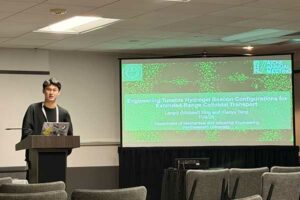
Xing presenting his research at AIChE 2025. Courtesy Photo.
His work explores how to speed up this process by controlling particle movement. By engineering concentration gradients of solutions like salt water and modifying the properties of microchannel surfaces, Xing can reshape how particles move and accumulate. This approach dramatically compresses drug delivery times from days to just hours. He presented this research at the 77th Annual Meeting of the Division of Fluid Dynamics in Salt Lake City in 2024.
Building on this work, Xing recently developed tunable hydrogel “beacons”—gel-based structures pre-loaded with chemical solutes. These beacons create sustained chemical gradients that can attract or repel tiny particles through what he calls “solute-inertial” interactions. By varying beacon shapes and the types of solutes used, these hydrogels generate overlapping chemical fields that can selectively sort and organize specific particle mixtures—all without requiring pumps or external power. He presented this research at the 2025 AIChE Annual Meeting in Boston.
Xing credits the resources available in EXP—including 3D-printing and laser cutting workshops—with enhancing his research capabilities. He also values quarterly events like the New England Complex Fluids workshop, which provides opportunities to connect with peers and experts in the field while building future collaborations. These resources have improved not only his technical knowledge but also his ability to apply and communicate his research effectively.
Xing is grateful for the mentorship he has received throughout his academic journey. He credits his advisor, Professor Tang, with building his research and experimentation skills “from the ground up”. He recalls taking how effectively she transferred knowledge to students in her courses and admires the upbeat energy she brings to their meetings. “She is always responsive to my inquiries and questions,” he notes.
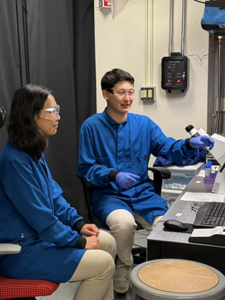
Xing (right) completing an experiment with his advisor, Professor Tang (left).
Looking ahead
One lesson Xing has learned is to seize every opportunity available. This mindset led him to participate in departmental seminars, “coffee hours,” and expos for both MIE and the College of Engineering. Putting himself out there allowed him to build community with his peers, share ideas, and develop strong communication and public speaking skills.
After completing his PhD, Xing plans to pursue a career in industry, where his research can address real world problems. He is particularly interested in the pharmaceutical field, where he can apply his combined expertise in mechanical and chemical engineering to improve drug delivery and medical treatments. Ultimately, Xing aims to translate innovative research into practical solutions that make people’s lives easier—fulfilling the goal that first drew him to engineering.